
Articles sur le même thème :


Currently, one of the major threats to worldwide health is the increasing antimicrobial resistance to antibiotics. In recent years, several global reports have shown increasing rates of resistance in bacteria, causing life-threatening infections and leading to inefficacy of antibiotic treatments. According to the World Health Organization (WHO), antibiotic resistance rose in over 40% of the pathogen-antibiotic combinations monitored between 2018 and 2023 [1], and WHO has warned about the potential consequences of a “post-antibiotic” era, in which common infections and minor injuries that have been successfully treated in the last decades may become dangerous in the near future. A list of antibiotic-resistant “priority pathogens” has been published, encompassing several families of multidrug-resistant bacteria, including a most critical group formed by Acinetobacter, Pseudomonas and various Enterobacteriaceae (Klebsiella, Escherichia coli, Serratia, and Proteus), that have become resistant to the best available antibiotic options for treating multidrug-resistant bacteria [2].
This worrying scenario has intensified the search for alternative antimicrobial molecules, ideally with broad-spectrum activity, novel mechanisms of action and low toxicity. Among the arising possibilities, antimicrobial peptides (AMPs) seem to be promising candidates to address the global antibiotic crisis.
What Are Antimicrobial Peptides (AMPs)?
AMPs are small amino acid sequences (usually comprising 10 to 100 amino acids) that are able to disturb microbial growth, mainly by interfering with the cell wall or membrane through electrostatic interactions and causing cell lysis. They may also present non-lytic mechanisms of action, interacting with intracellular components such as DNA, RNA and enzymes that are essential for cell survival and replication. One of the first AMPs to be isolated was nisin, extracted from Lactococcus lactis. It has effective activity against several Gram-positive bacteria, and has been used for some decades as food preservative [3].
Natural AMPs are found in diverse organisms, from microbes to superior eukaryotes, having an important role in modulating mutualism and antagonism interactions between organisms in their natural habitats. For example, several microbes produce AMPs that eliminate their competitors in order to occupy their place.
There are numerous natural AMPs, typically showing potent and broad-spectrum antimicrobial activity, and can be active against bacteria, viruses, fungi and protozoa. They exhibit structural diversity, presenting different secondary and tertiary structures, and frequently showing post-translational modifications (PTMs), which are crucial for their biological activity. These structural features allow them to interact with microbial targets like the cell membrane, the cell wall, or intracellular components through several mechanisms such as formation of membrane pores, inhibition of cell wall synthesis or inhibition of enzymatic activity (Figure 1) [4]. Furthermore, AMPs are able to modulate the host immune response.
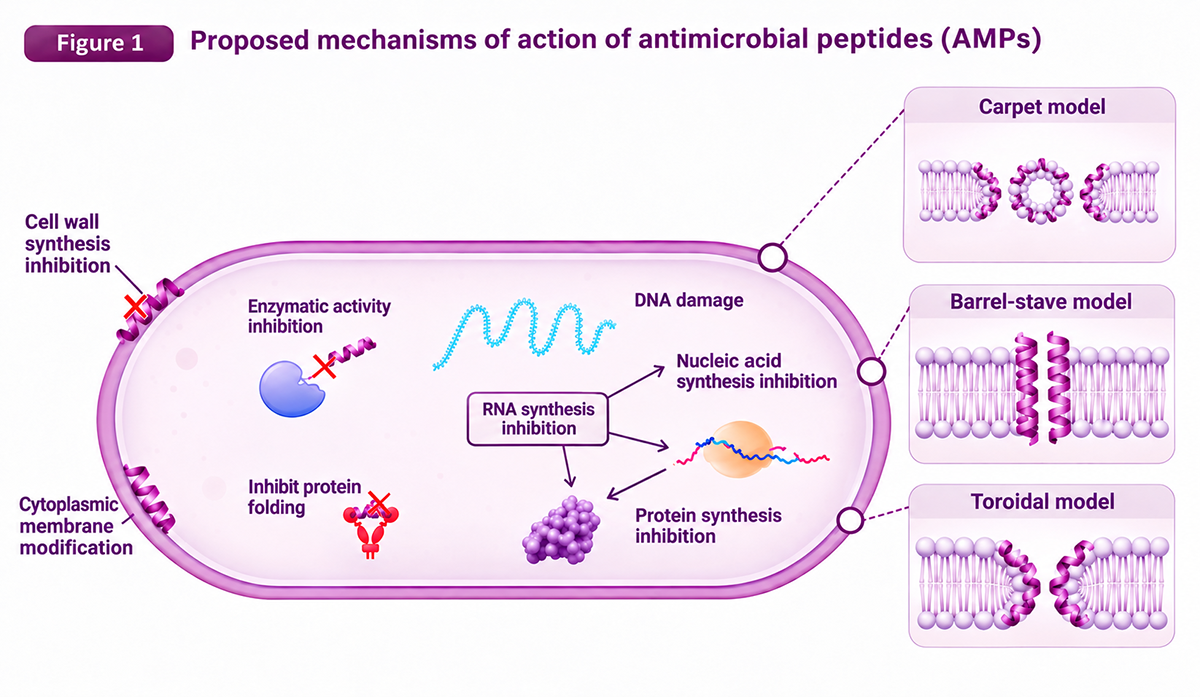
Figure 1 – These include (i) membrane pore formation via the Barrel-stave, Toroidal, and Carpet models, (ii) inhibition of cell wall synthesis, and (iii) modification of the cytoplasmic membrane. Intracellularly, AMPs affect (iv) enzymatic activity, (v) protein folding, (vi) protein synthesis, (vii) nucleic acid synthesis and (viii) induce DNA damage. Reproduced from [4].
Antimicrobial Peptides as Alternatives to Conventional Antibiotics
Several characteristics of AMPs have renewed the interest in these molecules as alternatives to traditional antibiotics and promising candidates to face the global antibiotic crisis. First, the majority of AMPs show strong activity against a wide range of pathogens, including bacteria, viruses, fungi and parasites. This broad spectrum is particularly important for the treatment of infections caused by multidrug-resistant organisms. Additionally, the diversity of effects shown by AMPs differentiates them from conventional antibiotics, and the development of resistance to many AMPs occurs at low levels and it is not related with resistance to other classes of widely-used antibiotics, due to their unusual mechanisms of action. Most AMPs act directly at the cellular membrane, show a relatively high killing rate, and resistance against AMPs is conferred by non-specific mechanisms, which minimizes the occurrence and transfer of resistance genes. Besides, both lytic and non-lytic mechanisms of action of AMPs result in minimum damage to host cells, which is an attractive aspect considering their use as new and more efficient antibiotics.
Furthermore, as they are able to modulate the host immune response, AMPs can help preserving the immune homeostasis, by increasing the recruitment of immune cells to the infection site, modulating cytokine production and promoting tissue repair, which can be advantageous for the treatment of infections with inflammatory or auto-immune features [5].
AMPs can be used alone or in combination with traditional antibiotics, potentiating their effects and, thus, reducing the required dosage and slowing the development of resistance.
Challenges in Antimicrobial Peptide Production
The potential of AMPs as alternative and advantageous antimicrobials has been counterbalanced by challenges in their production, including low yields and proteolytic degradation, which impair production in large scale required for clinical use. Large-scale production is also needed to allow a thorough characterization of AMPs, regarding their structure, function and mechanisms of action, which is essential to understand their interactions with the pathogen targets and to optimize their efficacy and safety.
Initially, AMPs were isolated from natural sources, but the extraction procedure is slow, expensive, and generates low yields of impure products. On the other hand, chemical synthesis offers a precise control of the peptidic structure, enabling to obtain high yields of pure peptides, but is impractical due to high costs and complexity for large-scale production, being also more problematic for the synthesis of longer peptides (with more than 50 amino acids).
Heterologous expression systems seem to be more cost-effective and scalable than natural and chemical production, although they can be time- and labour-expensive as they include cloning, production and purification steps. Also, the selection of the expression system is crucial since it can affect the biological activity of the produced AMP, as well as the production costs and yields. Besides, some bacterial systems show limitations in the production of AMPs with disulfide bonds or PTMs such as glycosylation. For instance, E. coli is frequently used as expression system to produce AMPs, but presents some difficulties in the synthesis of small and positively charged peptides, which are more susceptible to degradation, contamination and misfolding, due to the limited capabilities of the bacterium to perform PTMs. Furthermore, optimization in the heterologous expression of AMPs is complex, as improvements in one feature (for example antimicrobial activity) can negatively affect others (such as safety or stability).
Table 1 summarizes the main advantages and disadvantages of natural, chemical and recombinant methods used for AMP production [4].
Table 1 – Main advantages and disadvantages of natural, chemical and recombinant methods used for AMP production. Reproduced from [4].
Cell-Free Expression Systems for Antimicrobial Peptide Production
Efforts are being made to develop expression systems that allow the production of AMPs in a commercially-viable manner. Cell-free (CF) expression systems show improved performance regarding the synthesis of AMPs, enabling to surpass the high-cost barrier associated with other expression systems. Besides, CF expression platforms are not affected by the toxicity presented by some peptides since AMPs are produced without a living host. Furthermore, the Cell-Free production process allows the fast prototyping and generation of peptide libraries in a cost-effective way. When combined with machine learning-guided design, Cell-Free systems are valuable platforms to accelerate the discovery and scalable production of AMPs.
In contrast with traditional protein expression systems, Cell-Free systems synthesize peptides and proteins in an open and controlled environment, allowing rapid and flexible experimentation. This converts CF platforms in useful tools for the discovery, design, screening and biomanufacturing of AMPs. Cell-Free expression systems can offer major contributions in several key areas concerning the production of AMPs, namely (1) identification of mechanisms of action; (2) characterization of the biosynthetic pathways; (3) high-throughput screening; and (4) direct and rapid synthesis of AMPs with complex structures [6]. Moreover, Cell-Free systems can operate in an integrated form to include all the stages from discovery to efficient production of AMPs.
2. Characterization of Antimicrobial Peptide Biosynthetic Pathways
Elucidation of the biosynthetic pathways of AMPs is crucial to comprehend how these peptides are assembled, modified and matured. This provides valuable information on how to manipulate and optimize the biosynthetic pathways in order to achieve higher production yields and improved antimicrobial activity. The use of Cell-Free systems facilitates the study of biosynthetic pathways because each biosynthetic step can be independently controlled by using specific enzymes and separate reactions [8]. Furthermore, a set of substrate analogs for a particular enzyme can be determined and new enzymes can be engineered, aiming the discovery of new AMPs that may be inaccessible employing methods in vivo.
3. High-throughput screening of AMPs
In combination with high-throughput techniques and machine learning algorithms, Cell-Free systems enable the selection of AMPs from a peptide library, by screening a wide array of potential peptide sequences to identify those with the desired characteristics, such as high antimicrobial activity, high stability or low toxicity (Figure 2).
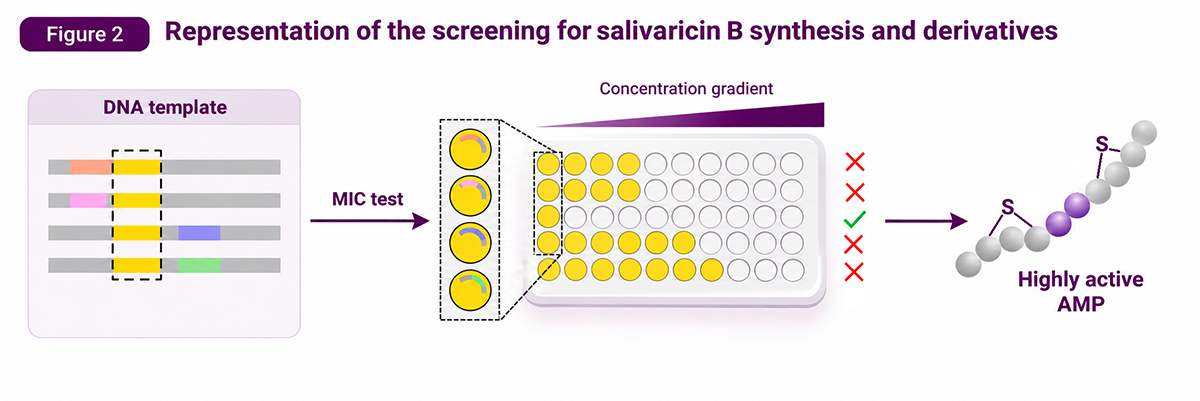
Figure 2 – Representation of the screening for salivarisin B synthesis and derivatives [9]. A library containing mutations of the wild-type salivaricin B structure was produced by genome mining and screening platforms. The enzyme-binding sites (light blue) remained intact during mutagenesis. A Cell-Free expression platform enabled to discover a novel salivaricin B derivative (marked with a green signal) with high antimicrobial activity against Gram-negative bacteria. Reproduced from [6].
CF platforms have shown to be cost-effective for screening large peptide libraries, allowing adjustments in the synthesis of peptides, which further improves the efficiency of the screening process. In addition, the optimal reaction conditions can be identified in order to obtain higher yields. Moreover, CF systems can be used to reconstruct large non-ribosomal peptide synthetases and directly synthesize natural products by supplementing the reaction with a DNA template. This way, Cell-Free expression systems can exceed the limitations of traditional cell-based expression systems that are not as flexible in the control of the synthetic conditions [6].
The association of Cell-Free systems and deep learning models have enabled the discovery of new AMPs, allowing to generate multiple AMPs from synthetic DNA fragments in a short time. The generated AMPs can then be evaluated by determining the minimum inhibitory concentration (MIC) within the Cell-Free system, in an integrated way (Figure 3).
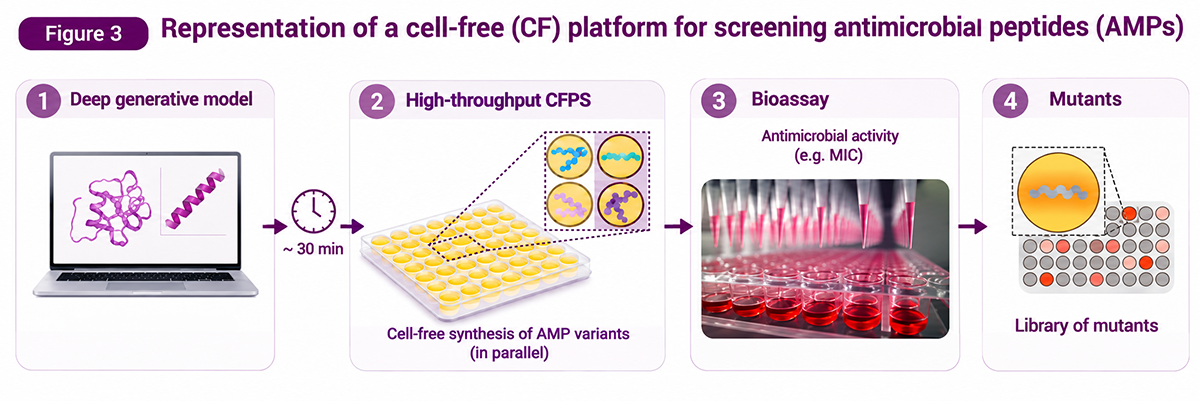
Figure 3 – Representation of a Cell-Free platform for screening AMPs. A deep generative model is integrated with the CF system to design AMPs de novo. AMPs are rapidly synthesized in the Cell-Free system from a synthetic DNA template and directly tested against bacterial cultures. Reproduced from [6].
For example, a CF production pipeline was developed for the rapid and cost-effective expression of AMPs from DNA templates. Deep learning models were used to design thousands of AMPs de novo, from which a more reduced number was selected by computational methods. The selected peptides were produced and screened by the CF system, which were then characterized and assessed for antimicrobial activity and toxicity. The develop pipeline demonstrated the potentialities of Cell-Free systems for high-throughput and low-cost production and evaluation of AMPs in less that 24 hours [10].
4. Cell-Free Synthesis of Structurally Complex Antimicrobial Peptides
Natural AMPs frequently have complex molecular structures that promote their binding to the targets, thus improving their bioactivity at low concentrations and minimizing the occurrence of off-target effects. These complex structures are also more stable and resistant to proteolytic degradation inside the cells. Cell-Free expression systems offer superior performance for the synthesis of these complex structures since they assure a correct folding of the peptides, enable the incorporation of non-canonical entities and simultaneously protect the translated products from degradation and aggregation [11].
The open reaction conditions typical of CF expression systems allow the addition of a variety of non-canonical amino acids in the reaction medium and their incorporation in the structure of the peptide, without being impaired by cellular uptake or toxicity, which can be problematic in in vivo expression systems. This possibility has increased the structural diversity of the AMPs that can be synthesized.
One example that illustrates the potentialities of Cell-Free systems for the production of AMPs with complex structures is the general approach proposed for the rapid prototyping of various disulfide-rich peptides, macrocyclic peptides, and complex disulfide-rich proteins, using an affinity resin that was added to the translation reaction [11]. The resin allowed to reduce aggregation of non-productive folding states or intermediates, yielding productive folding of all tested cysteine-rich peptides, independently of the number of disulfide bonds, embedded ring size or folding mode. The system was used to produce, purify and assay a number of therapeutically relevant peptides including cyclized or open backbones, and ranging from a simple disulfide bonded hairpin-like structure to complex knottins with intricate disulfide connectivity, in a rapid and cost-effective way.
Summary
The increase in microbial resistances to antibiotics is a serious worldwide health problem that threatens human life. The search for alternative antimicrobials that offer high antibiotic activity while being less affected by microbial resistances is an urgent demand, and antimicrobial peptides (AMPs) seem to be promising candidates due to their attractive features.
Large-scale production of AMPs is still challenging with traditional production systems, but cell-free expression systems are demonstrating superior performance in the synthesis of AMPs in diverse areas of interest, namely (1) identification of mechanisms of action, (2) characterization of the biosynthetic pathways, (3) high-throughput screening, and (4) direct and rapid synthesis of AMPs with complex structures. Several applications have been developed, confirming the advantages of cell-free production systems for the efficient, scalable and cost-effective synthesis of AMPs.
Written by Luísa Silva, PhD and scientific writer.
Accelerating antimicrobial peptide research with Synthelis Biotech
At Synthelis Biotech, we believe that accelerating the discovery of new antimicrobial compounds starts with overcoming the limitations of traditional protein expression systems.
With over a decade of expertise in cell-free protein synthesis (CFPS), we provide researchers with innovative tools and tailored services to support the expression, optimization, and screening of challenging proteins and peptides, including toxic antimicrobial candidates.
Our cell-free solutions offer several advantages for antimicrobial peptide research:
- Overcome cellular toxicity constraints: Our cell-free expression technology enables the production of proteins and peptides without relying on living host cells, making it particularly relevant for exploring antimicrobial candidates that may interfere with bacterial growth.
- Accelerate prototyping and optimization: Our Syn-Xpress™ kits provide a flexible, ready-to-use platform for rapidly testing expression conditions and evaluating different protein or peptide designs.
- Scale up discovery through high-throughput expression: Our High-Throughput Expression Platform combines cell-free technology, automation, and AI-assisted workflows to accelerate the production and screening of large libraries of protein and peptide variants.
- Benefit from customized scientific support: From expression feasibility studies and optimization to protein production and purification, our team provides tailored services to help researchers address their specific development challenges.
From peptide design to experimental validation
Whether you are exploring new antimicrobial sequences, investigating structurally complex peptides, or looking to accelerate your screening workflow, Synthelis Biotech can help you move faster from design to experimental evaluation.
Ready to explore the potential of cell-free expression for your antimicrobial peptide research?
Contact our scientific team to discuss your project and discover how our technologies and services can support your research.
Sources
[1] Global antibiotic resistance surveillance report 2025: WHO Global Antimicrobial Resistance and Use Surveillance System (GLASS). Geneva: World Health Organization; 2025. Licence: CC BY-NC-SA 3.0 IGO.
[2] WHO Bacterial Priority Pathogens List, 2024: bacterial pathogens of public health importance to guide research, development and strategies to prevent and control antimicrobial resistance. Geneva: World Health Organization; 2024. Licence: CC BY-NC-SA 3.0 IGO.