

Luminescence is the emission of radiation from a cold body substance, and involves two steps: excitation, in which an excited state is produced, followed by relaxation to the ground state through light emission. Luminescence has been widely used in scientific research and, particularly, fluorescence and bioluminescence have been extensively applied in the development of light-based assays, as they allow to detect and quantify biological events and enable to visualize molecular processes by using fluorescent or bioluminescent reporters and probes. Hence, fluorescent- and bioluminescent-based assays constitute valuable tools for monitoring and tracking gene expression, enzyme activity, metabolites, drugs or cells in in vitro and in vivo models [1,2]. Nevertheless, fluorescence and bioluminescence are based in different light emission mechanisms and the functional implications are, therefore, diverse, with each technique presenting strengths and limitations, which should be considered when deciding which strategy is right for your experiment.
What are fluorescence and bioluminescence?
Both fluorescence and bioluminescence are types of luminescence, but they can be distinguished by the underlying excitation mechanism. In fluorescence, the excitation of a molecule (fluorophore) results from light irradiation (Figure 1), whereas in bioluminescence the excited molecules are produced by particular biochemical reactions (Figure 2).
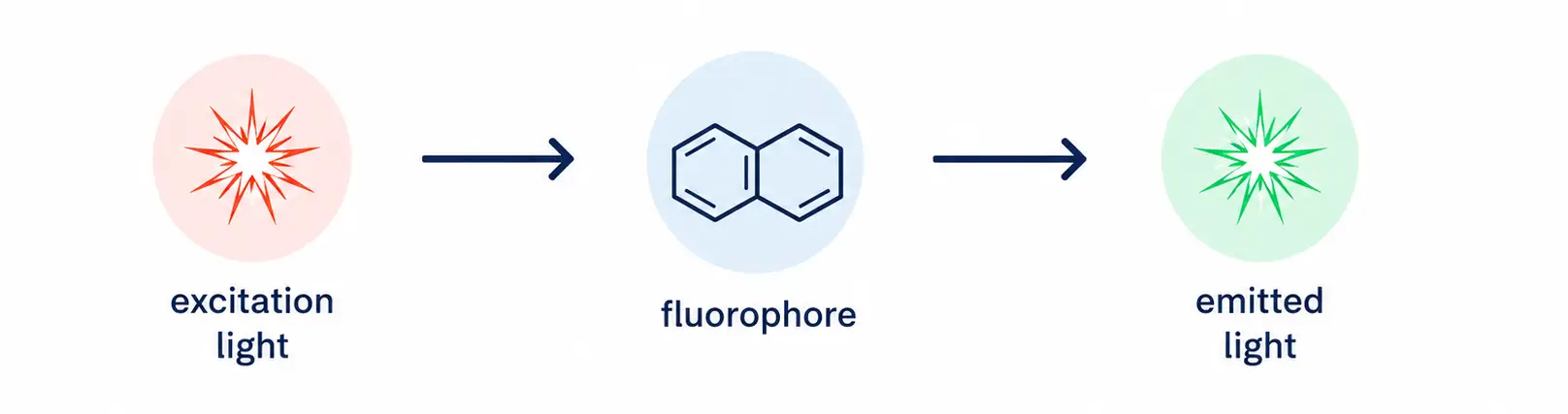
Figure 1 – Basic scheme of fluorescence.
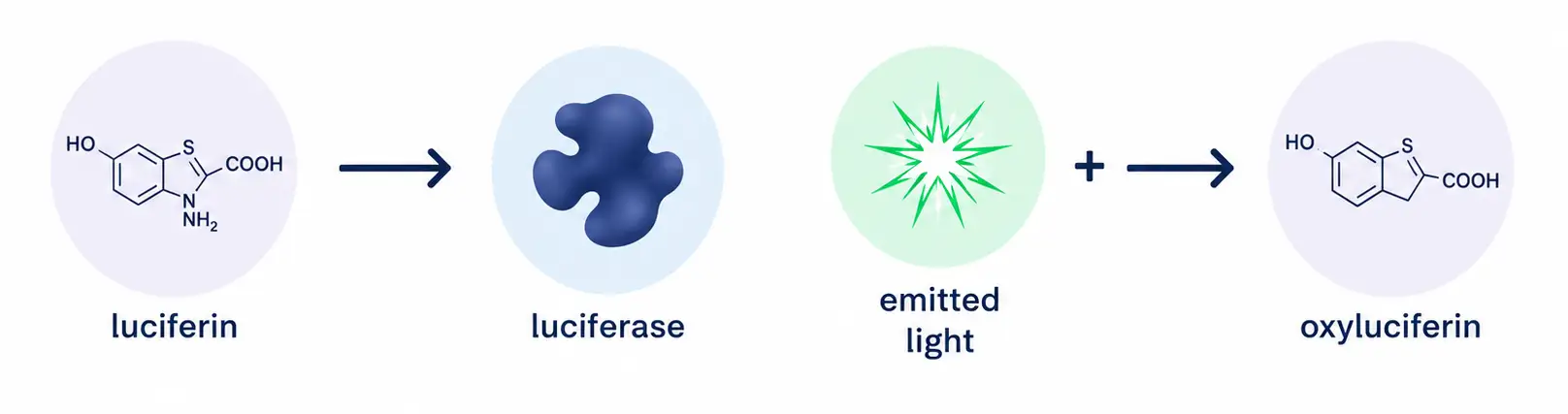
Figure 2 – Basic scheme of bioluminescence.
Certain living organisms, such as the firefly, produce light by enzyme-catalysed chemical reactions. In general, the process involves the oxidation of a compound (Sred) to an excited species (Sox*) that decays to the ground state (Sox) producing light as a byproduct, according to the following reaction:

In this scheme, A is a coreactant or cosubstrate and P is a reaction product. The biochemical reaction involves an enzyme and a substrate (the compound that is oxidized). For example, the luciferase enzyme, extracted from the Photinus pyralis firefly, uses adenosine-5´-triphosphate (ATP) as cosubstrate in the oxidation of luciferin by oxygen (Figure 3).
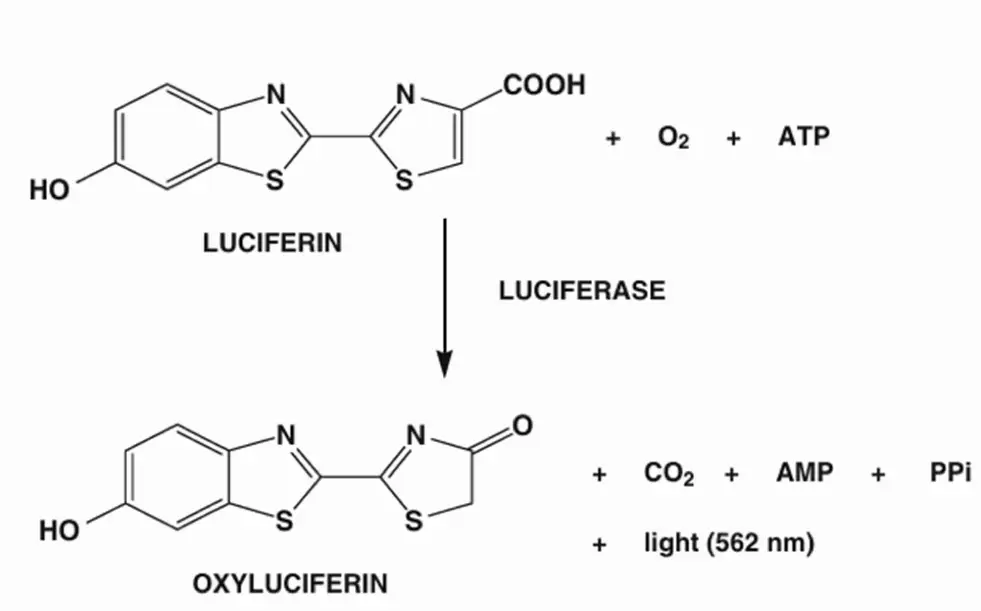
Figure 3 – Schematic representation of the oxidation of luciferin to oxyluciferin, catalysed by luciferase. Reproduced from [3].
Luciferases and their luciferin substrates are as structurally diverse as the organisms from which they are originated, each with their own fingerprint wavelength and quantum yield.
Key differences between fluorescence and bioluminescence
Fluorescence requires an external light source to irradiate the sample and induce fluorescence of the compounds in the sample. If the analyte is not fluorescent it can be labelled with a fluorescent tag (a fluorophore), which can be an organic dye, a metal complex or a luminescent nanoparticle. The fluorophore absorbs light at one wavelength and emits it at a longer wavelength, and filters are used to separate the excitation light from the emission light, enabling the detection of the signal of interest. The instrumentation is complex and includes the light source, filters to select excitation and emission light beams and a detector. Although it offers high flexibility for multiplexing (the use of multiple distinct fluorescent labels to simultaneously detect and quantify different targets), the high cost of the equipment may be a limitation. Another important drawback of fluorescence is the possibility of background light appearing, due to absorbance of the excitation light by the sample or the medium and the resulting autofluorescence, which can interfere in the detection, especially for low-abundant targets or heterogeneous samples. Consequently, the limit of detection is restricted to values higher than the expected for a background-free signal.
On the other hand, bioluminescence emits light through a biochemical reaction, and does not require an external light source. Therefore, the instrumentation is simpler than fluorescence-based equipments, not requiring the complex optical systems of fluorescent instruments. Additionally, the absence of an excitation beam avoids or minimizes the presence of scattered background light that could interfere in the assays, and allows to attain very low detection limits. Furthermore, the majority of biological systems don´t naturally emit bioluminescence, thus the signal-to-noise ratio is characteristically high, making bioluminescence particularly adequate to detect low-level signals. Yet, bioluminescent assays require a highly sensitive luminometer that can detect low intensity light signals, in order to provide accurate results
Table 1 summarizes and compares the main features of fluorescence and bioluminescence
Sensitivity and signal-to-noise ratio
Sensitivity refers to the ability of the method to discriminate between the analytical signal and the background signal.
Fluorescence provides high sensitivity since intense analytical signals can be generated, depending on the intrinsic characteristics of the fluorophores (namely the molar absorptivity and the fluorescence quantum yield) and the concentration of the fluorescent molecule (the intensity of the fluorescence signal is directly proportional to the concentration of the fluorescent molecule provided that the absorbance and, thus, the concentration, is very low). The analytical signal is also proportional to the power of the excitation beam and, therefore, the sensitivity can be enhanced by increasing the incident light. However, fluorophores can decompose under strong irradiation (photobleaching), so stability under irradiation is an important criterion in the selection of the fluorophore.
However, the efficiency of fluorescence and the emission wavelength are affected by the environment of the molecule, including the solvent, solution components or the other molecular fragment to which the fluorophore group is attached. The high background noise can reduce the effective sensitivity and make it more difficult to detect subtle differences in samples. In fact, the limit of detection is determined by background radiation emitted by sample components other than the analyte. Some strategies can be implemented to obviate this drawback. For example, background fluorescence of organic samples is usually limited to the visible region, so fluorescence can be advantageously measured in the infrared region.
In bioluminescence, the intensity of the emitted light is not as intense as in fluorescence. Nonetheless, the signal-to-noise ratio is typically higher. This is because the background noise is inherently minimal, since the majority of biological systems don’t present bioluminescent properties. Hence, bioluminescence becomes the best option for applications that require high sensitivity, such as tracking endogenous gene expression over time or monitoring signalling pathways in live cells.
Applications
The differences between fluorescence and bioluminescence influence their analytical applications. The choice between both techniques relies on their variations in what concerns spatiotemporal resolution and sensitivity.
Accordingly, fluorescence is the ideal option for imaging experiments, as it provides high spatial and temporal resolution, enabling the adequate tracking of labelled proteins in live cells and the visualization of tissue architecture. Furthermore, fluorescence offers the possibility of multiplexing, through the use of several fluorophores and filters, permitting the monitorization of various targets in the same sample. Therefore, fluorescence is optimal for flow cytometry, microscopy and imaging of cellular events in real time.
Alternatively, bioluminescence is more suited for applications that entail high sensitivity and minimal background interference. As the analytical signal is internally generated and does not demand an external source, bioluminescence exhibits better performance for live-cell and kinetic assays where the target is low abundant. Hence, the main applications of bioluminescence include monitorization of gene expression, assessment of protein-protein interactions and tracking dynamic signalling events over a period of time. Moreover, since bioluminescent-based assays are less phototoxic than fluorescent ones, they are milder for live cells during long-time experiments.
Considering the special case of live-cell imaging, it can be performed with fluorescence or bioluminescence, by using appropriate luminescent or fluorescent reporters. On one hand, fluorescence assays can be carried out using several reporters that enable temporal and spatial resolution, permitting to visualize changes throughout time or through different cell compartments. On the other hand, bioluminescence provides enhanced stability of the analytical signal, allowing to observe protein dynamics in live cells without the need for repeated excitation of the sample. This reduces phototoxicity and photobleaching, which can negatively affect cellular viability and the integrity of the signal over time.
Fluorescence imaging and multiplex labelling
In recent years, the development of new fluorescent molecules and probes has transformed the field of molecular imaging, and various biomolecules and physiological events in live cells are now easier to track. Several innovations have been reported, including the development of series of fluorophores that allow the simultaneous multicolour imaging, the improvement of fluorescence brightness, progresses in fluorophore labelling technology, the development of different types of probe design, and advances in photostability and signal-to-noise ratio. When compared with bioluminescence imaging, fluorescence imaging exhibits higher brightness, favouring the visualization of targets with optical resolution and in a time scale of milliseconds, and no substrates or cofactors are required. Owing to the developed innovations, fluorescence bioimaging is currently the most used technique to study spatiotemporal dynamics of target molecules and events in live entities [1].
In addition, fluorescence offers the possibility of multiplexing analysis. This refers to the use of multiple fluorophores to visualize various targets within a sample. Multiplexing allows the simultaneous observation of related components and processes, enriching the observation with the surrounding context, thus providing more information and meaningful results. Multiplexed real-time fluorescence detection can expose the stoichiometry, dynamics and interactions of multiple molecules in complex samples, in a multicoloured image [4].
Nonetheless, the choice of the right fluorophore combination for your experiment is decisive to achieve optimal results. Most fluorophores have a broad emission spectrum, so when two or more fluorophores are used, they might overlap causing signal crosstalk. If this is not accounted for, the data may be affected by false negatives or positives. To avoid or minimize crosstalk problems, the fluorophore excitation and emission spectra must match the system’s light source and filter set characteristics, and the emission spectra of each fluorophore must have minimal overlap.
Bioluminescent assays, luciferase assays and screening
Bioluminescence assays are based on the use of luciferase enzymes, which can be grouped by their family or luciferin substrate, and comprise D-luciferin reporters and coelenterazine reporters. Firefly luciferase (FLuc) is, probably, the most used luciferin reporter in the high-throughput screening (HTS) field. FLuc is an ATP-hydrolysing enzyme that uses ATP, metal cation, and luciferin substrates to yield oxyluciferin in an excited state, and photon emission (~560 nm) when the excited oxyluciferin relaxes back to the ground state. FLuc shows high luminescent activity across a broad linear range of about seven orders of magnitude [5].
Various bioluminescent assays have been developed for diverse applications, namely cell proliferation and viability assays, enzyme activity assays and reporter gene assays, among others. The most common application of bioluminescence in HTS is, possibly, the determination of cell viability and proliferation, which is based on the requirement for ATP in the FLuc-mediated oxidation of D-luciferin and in the fact that only viable cells produce ATP (Figure 4a). In enzyme activity assays, ATP-sensing assays measure the activity of ATP-consuming enzymes, and the luminescence signal is correlated to the ATP level, or inversely proportional to the enzyme activity (Figure 4b). In reporter gene assays, by cloning the regulatory region of a gene of interest upstream of a luciferase gene or expression vector, the luminescent signal can be used to measure the activity of the regulatory element or proteins in the biological pathway affected by the target element (Figure 4c). Reporter assays are frequently used for HTS approaches, where fast and cost-effective readouts are needed to rank targets in screening procedures.
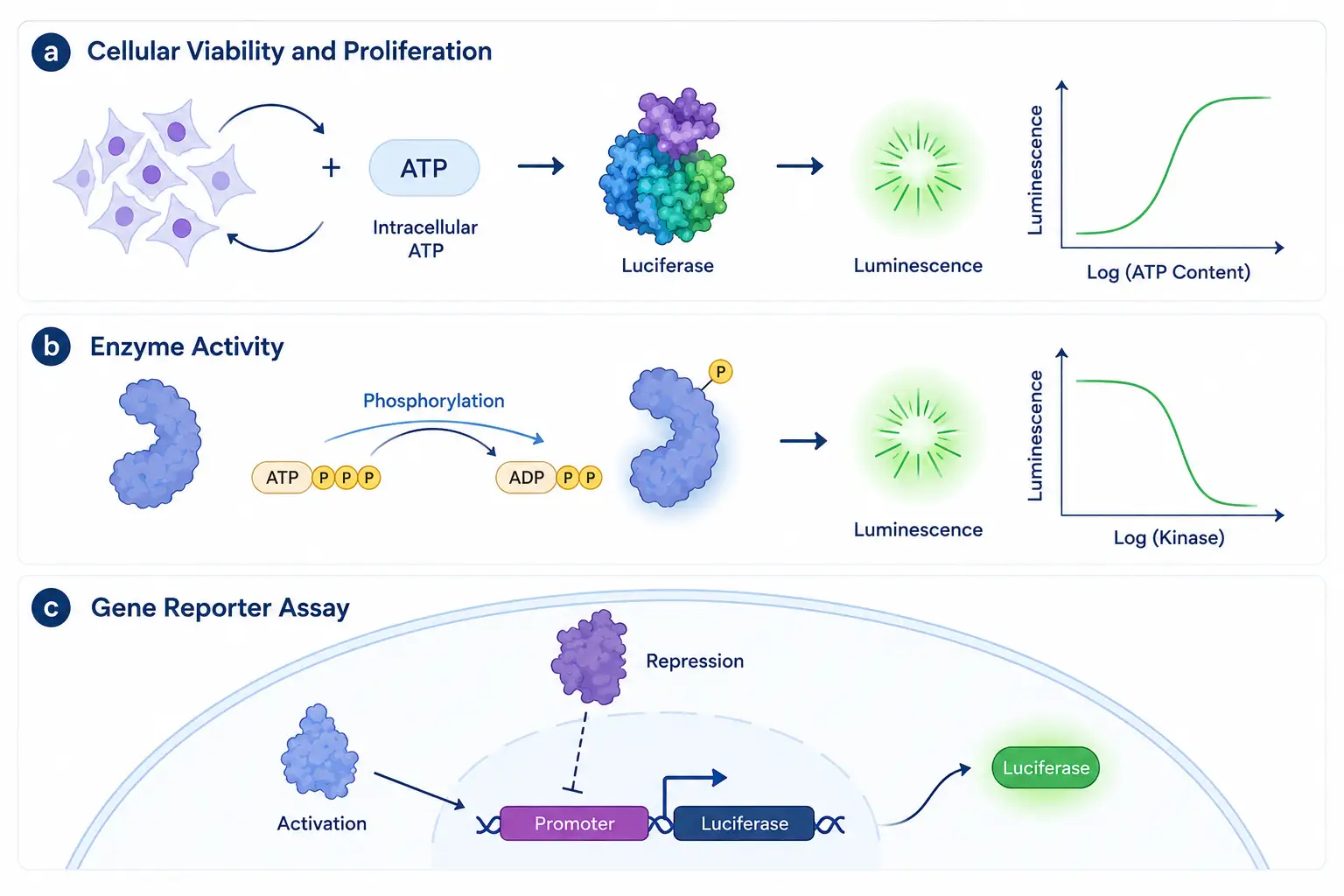
Figure 4 – Schematic representation of several luminescent-based assays. Reproduced from [2].
When should you choose bioluminescence?
If sensitivity and signal-to-noise ratio are the crucial aspects in your experiment (for example, when detecting weak signals in live cells or measuring dynamic responses over time), bioluminescence is the best choice. The absence of autofluorescence and photobleaching makes it especially effective for low-abundant targets and long-term kinetic studies. Furthermore, bioluminescence-based assays address the current need to perform rapid, high-throughput and cost-effective testing and enable to carry out enzymatic assays with accuracy and high sensitivity.
Recent advances in the luminescent output, structure, and function of both the luciferase enzymes and their substrates have expanded the applications of bioluminescence in assaying target activity, dynamics, and interactions. Additionally, progresses in bioluminescence microscopy have overcome challenges, like long image acquisition times, leading to the successful imaging of cellular structures at the single-cell level. Newly developed bioluminescent probes offer improved sensitivity over traditional fluorescent probes and are likely to expand the range of applications of these tools.
Unlock the Potential of Cell-Free HTS
Cell-free protein production is revolutionizing high-throughput screening, enabling faster, more efficient, and more versatile research across multiple fields. Whether you are exploring drug discovery, enzyme engineering, or membrane protein analysis, adopting a cell-free HTS approach can significantly accelerate your findings.
Summary
Fluorescence and bioluminescence are two forms of luminescence, which is the emission of radiation from a molecule, involving two steps: excitation, in which an excited state is produced, followed by relaxation to the ground state through light emission. In fluorescence, the excitation of a molecule (fluorophore) results from light irradiation, whereas in bioluminescence the excited molecules are produced by particular biochemical reactions.
Written by Luísa Silva, PhD and scientific writer.
Sources